Seth Hufstedler was a legend within our Los Angeles legal community. A Past President of LACBA (1969), a true gentleman, and a well-respected colleague and friend to many of us. He will be dearly missed. – Sarvenaz Bahar, 2024-2025 LACBA President
MetNews Obituary
Seth Hufstedler: Brilliant Lawyer, Exceptional Leader, Generous Mentor
By Kathleen Tuttle, longtime LACBA member and author of Lawyers of Los Angeles: 1950 to 2020
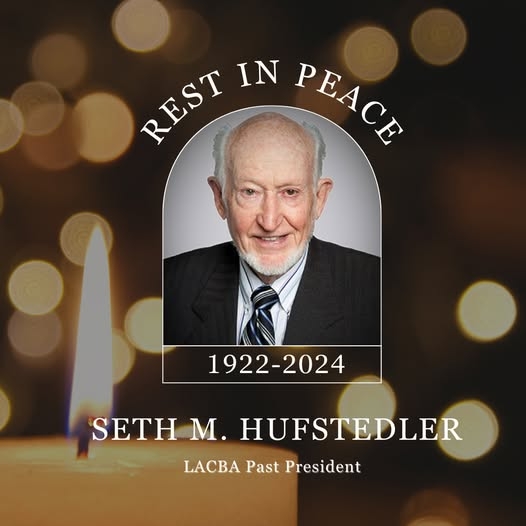 Our dear friend and Los Angeles County Bar Association member, Seth M. Hufstedler, passed away on Dec. 20 at the age of 102, following 74 years of active practice that included serving as LACBA’s president in 1969. Leafing through the pages of the County Bar and State Bar Journals, the Los Angeles Times – and indeed the California Appellate Reports – from the 1950s forward, one can easily see the indelible mark he left on our legal profession and community.
Seth was born on September 20, 1922, in Dewar, Oklahoma where his father ran a general store. When Seth was five years old, his family moved to California to be near relatives in the Bay Area. Along the way, they stopped at a motor hotel in Bakersfield and never made it further because Seth’s father liked what he saw and bought the business. Seth grew up in the motor court where he met all kinds of personalities – perhaps a secret to his future success as a skilled trial lawyer -- and attended Bakersfield High School where he was a standout student. As a member of the speech and debate team, he finished first at the State Championships in Extemporaneous Speaking. In 1939, Seth attended USC as an undergraduate and enrolled in ROTC.
Hufstedler then attended Stanford Law School, graduating in 1949. His celebrated class included Shirley M. Hufstedler (whom he married shortly after graduation), Warren M. Christopher (O’Melveny & Myers), and Robert G. Thompson (Tuttle & Taylor). Seth was number 1 in his class, and Shirley tied with Christopher for number 3. Seth and Shirley helped to found the Stanford Law Review, where Seth was the Legislation Editor. His article, in Volume I, Issue 1 of the Stanford Law Review, entitled “Who Owns the Clouds?” is still cited today.
Those were very different times; in Seth’s final year at Stanford, the FBI was the only entity that recruited on campus. Left to his own devices, he secured his first job with Lillick, McHose & Charles in downtown Los Angeles. Two years later, Seth established a practice with Charles E. Beardsley, whom he had met when he was looking for his first job. Chuck was a generation ahead of Seth at Stanford and an extraordinarily bright, prominent, lawyer-leader who mesmerized juries, and who Seth remarked “could move mountains when he wanted to.”
The Beardsley law firm underwent several name changes – including Beardsley, Hufstedler & Kemble; Hufstedler, Miller, Carlson & Beardsley; then Hufstedler, Miller, Kaus & Beardsley; and ultimately Hufstedler & Kaus, before merging into Morrison & Foerster in 1995.
Seth assumed many noteworthy leadership roles throughout his career. He was president of LACBA in 1969, president of the State Bar in 1973-74, and consistently took courageous positions along the way. In the early 1950s, his firm of Beardsley & Hufstedler hired Helen Kemble as the first female lawyer who became a founding partner in 1955 in an established downtown law firm on her own merit. In the early to mid-1960s, the firm was the first to break the color line in downtown law firms by hiring Sam Williams, who soon became a partner.
In reaction to a controversial judicial ruling in 1970 requiring school busing in Los Angeles after which the judge lost his seat during a heated campaign vilifying him, Hufstedler wrote in the President’s Page of LACBA’s Bar Bulletin:
“The strength of our judicial system lies in the fearless and independent judiciary. If each judge is going to be required to look over his shoulder at his popularity rating before he makes a decision, our entire judicial system is doomed to failure. Cases come to court because people feel strongly, even violently, about diverse points of view. Judges cannot duck those hard cases but are required to decide them. The losing side in each case may well be hurt, angry, and upset. Nevertheless, the judge should not be required to decide the case on the strength of the virulence of the reaction of the losing party.”
In 1979, Hufstedler was appointed as special counsel to the Commission on Judicial Performance for its televised hearings into the workings of the California Supreme Court amid controversy over the delay – arguably for political purposes -- in the release of two criminal law decisions (Tanner). The entire matter was without precedent and required the Supreme Court to “wash its dirty linen” in public. Said one participant: “Seth Hufstedler may be among the last of the breed of generally acknowledged leading lawyers.” Another close observer commented: “Hufstedler was an inspired choice . . . he could be counted on to conduct a fair and balanced investigation without turning the proceedings into the witch hunt they could easily have become.”
Seth’s focus was commercial litigation, and often involved “bet-the-company” court battles. His penetrating intelligence has long been recognized, and was readily apparent, in his final appearance before the U.S. Supreme Court in 1999, when he represented the Governor of Guam and succeeded in reversing a Ninth Circuit decision by a 9-0 vote.
Leadership and scholarly brilliance help define Seth’s qualities as a first-class lawyer, but one further ingredient really set him apart: his ability to inspire countless young lawyers with his guidance and encouragement. Seth was a marvelous intellectual companion. Many credit him with shaping their careers and instilling in them the values of fairness and professionalism. They include Patricia Phillips, Sam Williams, Burton Gindler, Dennis Perluss, Harry L. Hupp, Philip M. Saeta, John Sobieski, Pierce O’Donnell, Evelyn Balderman Hutt, Peter Israel, Laurie Zelon, Janie Schulman, David McDowell, Silvia Rivera, Marlo Metzner, Steve Haines, Jack Alden, Mike Feuer, John Hoffman, John Olson, Mary Healy, Gary Plessman, Jerry Craig, and so many more.
It cannot go unsaid that Seth and Shirley, together, may have quadrupled their impact on people. They both were serious thinkers with great curiosity and a keen interest in the world. When I interviewed them just before Shirley died in 2016, I asked about their favorite books. One said Gone with the Wind, the other, War and Peace. Nothing trivial or ill-considered, ever, from them. But rather, timeless and consequential.
Seth’s legacy will live through the great number of lives he touched and the principles he upheld. He will be profoundly missed by all who knew him.


 Copyright 2026 LOS ANGELES COUNTY BAR ASSOCIATION